
Swim Speed Guide
Swimming faster is not only about kicking harder or doing more laps. Most swimmers get faster when they reduce drag, improve their catch, breathe without breaking rhythm, and train with a clear purpose.
This guide breaks down three practical tips for swimming faster: improve body position, create a stronger pull, and build speed with smarter sets. These tips work for beginners, fitness swimmers, triathletes and lap swimmers who want more speed without wasting energy.
This article contains affiliate links. As an Amazon Associate, BestSwimGoggles.com may earn from qualifying purchases. This does not change the price you pay and does not control our editorial recommendations.
Quick Answer: What Are the Best Tips for Swimming Faster?
The three best tips for swimming faster are: reduce drag by improving body position, improve propulsion by fixing your catch and pull, and train speed with short focused intervals instead of only swimming long slow laps.
Focus on these three speed levers:
- Body position: Keep your head neutral, hips high and body long.
- Catch and pull: Hold water with your forearm and press backward, not downward.
- Speed training: Use short intervals, controlled rest and consistent pacing.
The fastest swimmer is not always the swimmer working the hardest. It is often the swimmer wasting the least energy.
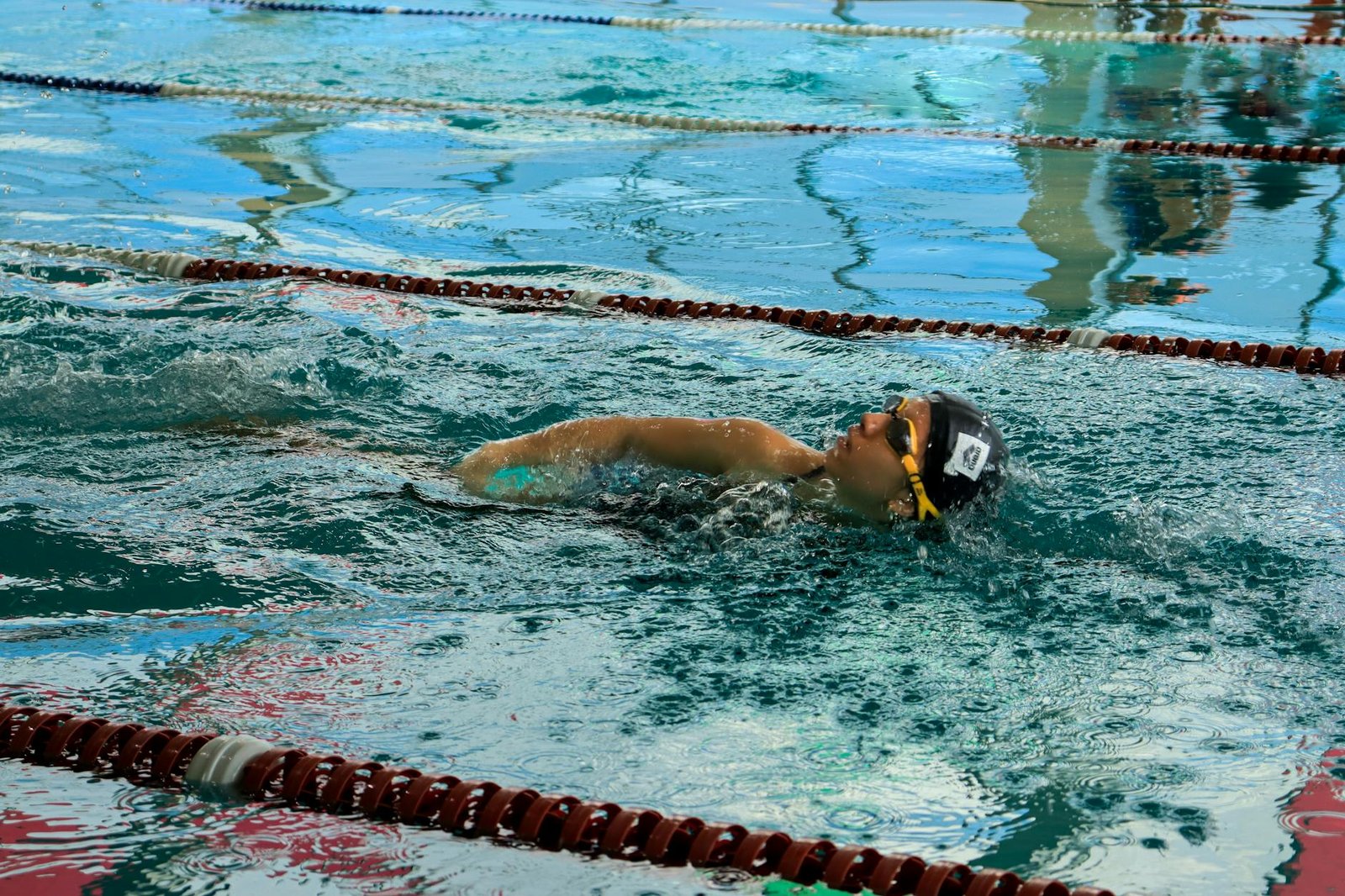
Why Most Swimmers Struggle to Get Faster
Many swimmers try to get faster by adding effort before fixing technique. They kick harder, spin the arms faster, or swim more laps, but their speed barely improves because drag and poor timing are still slowing them down.
Speed in swimming comes from a balance of efficiency and power. If your hips sink, your head lifts, your hand crosses over, or your elbow drops during the pull, you lose speed before fitness can help.
What Slows You Down
- Sinking hips and legs.
- Lifting the head to breathe.
- Crossing over on hand entry.
- Dropping the elbow during the catch.
- Kicking too big from the knees.
- Swimming every set at the same pace.
What Makes You Faster
- Better body alignment.
- Cleaner breathing rhythm.
- More effective catch and pull.
- Lower drag.
- Short speed sets with enough rest.
- Consistent technique under fatigue.
Tip 1: Reduce Drag Before Adding Power
The easiest way to swim faster is often not to pull harder. It is to make your body easier to move through the water. If your body position creates drag, extra effort will only make you tired faster.
| Drag Problem | What It Looks Like | How to Fix It |
|---|---|---|
| Head too high | Looking forward, hips sink | Look mostly down and keep the neck neutral |
| Sinking legs | Feet drag low behind the body | Engage core and keep a light steady kick |
| Crossing over | Hand enters in front of head or opposite shoulder | Enter in line with the same-side shoulder |
| Poor breathing | Head lifts, body twists, rhythm breaks | Rotate to breathe and exhale underwater |
| Big knee kick | Large splash, little forward movement | Kick smaller from the hips with relaxed ankles |
Try this body-position checklist:
- Look down or slightly forward, not straight ahead.
- Keep your head quiet when you breathe.
- Feel your chest pressing lightly into the water.
- Keep your hips close to the surface.
- Use a narrow kick instead of a big splashy kick.
- Enter each hand in front of the same shoulder.
For more detail on body position and stroke errors, read our guide to common freestyle technique mistakes.
Best Drills to Reduce Drag
Use these drills when your freestyle feels heavy, slow or tiring even at an easy pace.
| Drill | What It Fixes | How to Use It |
|---|---|---|
| Side kicking | Body balance and head position | 4 x 25 alternating sides |
| 6-kick switch | Rotation and streamlined side position | 6 kicks on one side, switch, repeat |
| Catch-up freestyle | Hand entry and body length | 4 x 25 drill, then 4 x 25 normal swim |
| Snorkel freestyle | Head position without breathing interruption | 4 x 50 easy focus on body line |
Tip 2: Improve Your Catch and Pull
Once your body position is cleaner, the next way to swim faster is to improve how you hold the water. Many swimmers move their arms quickly but do not actually push much water backward.
A better catch means your hand and forearm connect with the water early. Instead of pressing down, you angle the forearm and press water backward. That creates more forward movement with less wasted effort.
Weak Pull
- Elbow drops under the hand.
- Hand slips through the water.
- Pull pushes downward.
- Stroke feels busy but not powerful.
- You need to kick hard to keep speed.
Stronger Catch
- Elbow stays higher than the hand early.
- Forearm helps hold water.
- Pressure moves backward.
- Stroke feels connected.
- You travel farther per stroke.
Do not think “pull harder.” Think “hold the water better.”
Best Drills to Improve the Catch
These drills help you feel water pressure instead of simply spinning your arms faster.
| Drill | Purpose | Set Example |
|---|---|---|
| Sculling | Feel water pressure with hands and forearms | 4 x 25 slow scull |
| Closed-fist freestyle | Use forearm, not just hand | 4 rounds: 25 fist drill + 25 swim |
| Single-arm freestyle | Focus on one catch at a time | 4 x 25 right arm, 4 x 25 left arm |
| Pull buoy freestyle | Isolate catch and upper-body rhythm | 6 x 50 moderate pull |
| Light paddle work | Advanced catch awareness | Short controlled sets only |
Check Pull Buoys
Check Swim Paddles
Use paddles carefully. If your shoulder hurts or your catch is unstable, fix technique first before adding resistance.
Tip 3: Train Speed With Short Focused Intervals
If every swim is the same long steady pace, your body gets good at swimming one speed. To swim faster, you need short sets where you practice faster swimming while keeping technique under control.
Speed training does not mean thrashing. It means swimming faster with enough rest that you can keep good form.
| Training Goal | Set Example | Focus |
|---|---|---|
| Basic speed | 8 x 25 fast, rest 30 seconds | Fast but clean technique |
| Pace control | 6 x 50 moderate-fast, rest 20 seconds | Same time each repeat |
| Stroke efficiency | 4 x 50 count strokes, rest 20 seconds | Speed without adding extra strokes |
| Power | 6 x 25 with fins, rest 30 seconds | Fast kick and body line |
| Endurance speed | 5 x 100 steady hard, rest 30 seconds | Hold form while tired |
Sample Workout: Swim Faster Without Losing Form
Use this workout once a week when your goal is speed plus technique, not just yardage.
| Warm-up | 200 easy swim, relaxed breathing |
| Technique prep | 4 x 25 catch-up freestyle + 4 x 25 closed-fist freestyle |
| Body position | 4 x 25 side kicking or 6-kick switch |
| Main speed set | 8 x 25 fast but clean, rest 30 seconds |
| Pace set | 6 x 50 moderate-fast, rest 20 seconds |
| Cool-down | 100 easy swim or backstroke |
Stop the speed set if your form falls apart. Bad fast swimming teaches bad habits.
How to Know If You Are Actually Getting Faster
Do not judge progress only by how tired you feel. Faster swimming should show up in measurable ways.
Track these signs:
- You swim the same distance with fewer strokes.
- Your 25 or 50 repeat times improve.
- You can hold the same pace with less rest.
- Your breathing feels calmer at faster speeds.
- Your legs stay higher in the water.
- Your stroke feels more connected and less frantic.
- You finish sets with more consistent times.
A simple way to track progress is to record your time and stroke count for 4 x 50 once a week. If your time drops while stroke count stays the same or improves, your efficiency is getting better.
Helpful Gear for Swimming Faster
Gear will not make you fast by itself, but the right tools can support better technique and more focused training.
| Gear | How It Helps | Check Gear |
|---|---|---|
| Anti-fog goggles | Clear vision helps you keep head position and focus during speed sets | Check Goggles |
| Pull buoy | Helps isolate the catch and upper-body rhythm | Check Pull Buoys |
| Swim paddles | Can build catch awareness and pull strength for experienced swimmers | Check Paddles |
| Training fins | Support body position, kick speed and rotation drills | Check Fins |
| Tempo trainer | Helps practice stroke rhythm and pacing | Check Tempo Trainers |
| Swim snorkel | Lets you work on body line without turning to breathe | Check Snorkels |
Common Mistakes When Trying to Swim Faster
Avoid these mistakes:
- Spinning the arms faster without improving the catch.
- Kicking harder while the hips are still sinking.
- Holding your breath during fast sets.
- Swimming every workout at the same pace.
- Adding paddles before your shoulders and technique are ready.
- Ignoring stroke count and only chasing effort.
- Doing speed work when you are too tired to hold form.
- Using foggy or leaking goggles that interrupt head position.
Frequently Asked Questions
What is the fastest way to improve swimming speed?
The fastest way to improve swimming speed is to reduce drag first, then improve your catch and pull, then add short focused speed intervals. Technique usually creates faster gains than simply swimming more laps.
How can beginners swim faster?
Beginners should focus on body position, relaxed breathing, a narrow kick and clean hand entry. Trying to sprint before fixing these basics often leads to more fatigue instead of more speed.
Should I kick harder to swim faster?
Not always. A huge kick from the knees can create drag and waste energy. A narrow kick from the hips supports body position and speed more efficiently.
How do I get a stronger freestyle pull?
Practice sculling, closed-fist freestyle, single-arm freestyle and pull buoy sets. Focus on holding water with the forearm and pressing backward rather than pushing downward.
How often should I do speed sets?
Most fitness swimmers can do one or two speed-focused sessions per week, depending on experience and recovery. Keep the repeats short and stop when technique falls apart.
Do better goggles help you swim faster?
Goggles do not create speed directly, but clear, comfortable, leak-free goggles help you keep better head position, breathe more calmly and focus during faster sets.
Final Takeaway
To swim faster, do not start by fighting the water harder. Start by moving through the water cleaner. Improve your body position, build a better catch, and train speed with short focused intervals.
Once your technique wastes less energy, every bit of fitness and power goes further. That is how swimmers get faster without feeling like they are simply working harder every lap.
